
Introduction: Why Good Technology Plans Still Fail in Execution
Your business has identified an opportunity for AI. You have discussed the use case, evaluated available technologies, and perhaps even built a proof of concept.
But the project is not delivering the expected business value.
The AI model works in a demo, yet integrating it with your existing software is proving difficult. Your team is struggling with data quality, infrastructure decisions, security requirements, or unexpected edge cases. Meanwhile, the original timeline keeps slipping.
At this point, businesses often face a critical decision: hire a consultant to help determine the next steps or bring in an engineer who can work directly with the team and implement the solution.
This is where the distinction between a forward-deployed engineer (FDE) and a traditional consultant becomes important.
Both can help solve complex technical problems, but their typical responsibilities, deliverables, and levels of implementation ownership differ.
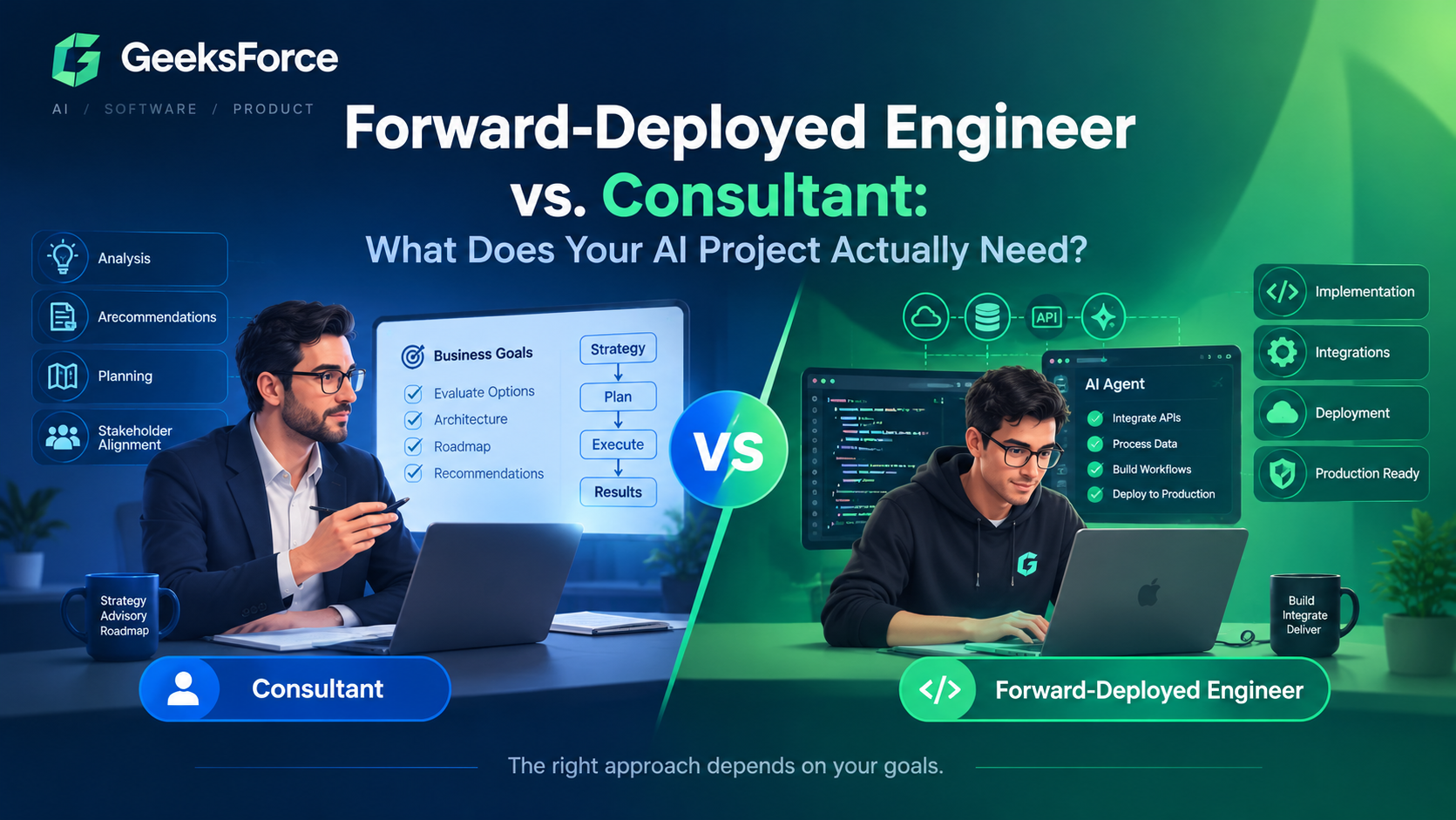
A consultant may help you understand what needs to change. A forward-deployed engineer typically works alongside your team to discover the technical constraints, build the solution, integrate it with existing systems, and move it toward production.
Neither approach is universally better. The right choice depends on what is blocking your project and what outcome your business needs.
In this guide, we compare both roles, explore their practical differences, and explain how to choose the right approach for your AI or software development initiative.
What Is a Forward-Deployed Engineer?
A forward-deployed engineer is a customer-facing technical professional who works closely with a client’s team, systems, and operational workflows to solve real-world engineering problems.
Unlike an engineer working exclusively on a standardized product roadmap, an FDE spends significant time understanding the customer’s specific environment. That may involve examining an existing codebase, investigating APIs, working with production data, integrating third-party services, or adapting an AI system to an organization’s actual business processes.
The role combines software engineering, systems integration, technical discovery, and direct collaboration with stakeholders.
What does a forward-deployed engineer do?
Depending on the engagement, an FDE may:
- Investigate technical constraints in an existing application.
- Translate business problems into implementable engineering solutions.
- Design and build custom software integrations.
- Develop AI agents, RAG pipelines, and automated workflows.
- Work with real business data and existing infrastructure.
- Test performance, reliability, and security before deployment.
- Resolve integration issues discovered during implementation.
- Help teams operate the solution and transfer technical knowledge.
For example, a company might want an AI assistant that answers customer questions using internal documentation and live account information.
A forward-deployed engineer would work with the company to understand its data sources, authentication model, existing APIs, and support workflows. They would then help implement the retrieval pipeline, connect the required tools, enforce authorization, test real-world scenarios, and prepare the system for production.
The objective is not simply to demonstrate that AI can perform the task. It is to build a solution that works within the company’s actual technical environment.
What Does a Traditional Consultant Do?
A consultant helps an organization understand a problem, evaluate possible approaches, and determine the best course of action.
In technology and AI projects, this can involve strategic planning, technical assessments, architecture recommendations, vendor evaluation, process analysis, or implementation planning.
A consultant may work with business leaders, product managers, and engineering teams to identify opportunities and establish priorities before significant development resources are committed.
What does a technology consultant deliver?
Typical deliverables include:
- Technical assessments and architecture recommendations.
- AI opportunity evaluations and feasibility studies.
- Build-versus-buy analysis.
- Technology selection and vendor comparisons.
- Product roadmaps and implementation plans.
- Security, governance, and operational recommendations.
- Project plans, risk assessments, and success metrics.
Consider a company exploring AI automation across several departments.
Before building anything, leadership may need to understand which workflows offer the strongest return on investment, which data sources are suitable, what regulatory requirements apply, and whether existing tools can solve the problem.
A consultant can help answer these questions and establish a practical roadmap.
Importantly, consulting does not necessarily exclude hands-on development. Some consultants implement complete solutions, while others focus primarily on advice. The actual engagement scope matters more than the job title.
Forward-Deployed Engineer vs. Consultant: Key Differences
Although the two roles overlap, they tend to approach technical challenges from different starting points.
| Dimension | Forward-Deployed Engineer | Traditional Consultant |
|---|---|---|
| Primary focus | Implementing solutions in the client’s environment | Diagnosing problems and recommending solutions |
| Starting point | An operational problem requiring technical discovery and delivery | A business or technical question requiring analysis |
| Typical deliverable | Working software, integrations, and a deployed workflow | Assessment, recommendations, roadmap, or agreed implementation |
| Hands-on coding | Usually a central responsibility | Varies by engagement |
| Client collaboration | Close collaboration throughout engineering and deployment | Stakeholder meetings, analysis, and advisory sessions |
| Technical ownership | Often involved through production readiness and handover | Defined by the engagement; may end with recommendations |
| Success measurement | Working solution, adoption, reliability, and business impact | Quality of advice, decisions, implementation, or agreed outcomes |
| Best fit | Complex implementation with uncertain technical details | Strategic decisions, feasibility, and defined advisory needs |
These are typical patterns rather than rigid definitions. An implementation consultant may own production code, and a forward-deployed engineer may spend substantial time on strategy and discovery.
The practical question is not which title sounds more advanced. It is which professional will take responsibility for the work your organization needs completed.
When Should You Hire a Forward-Deployed Engineer?
A forward-deployed engineer is particularly useful when the objective is clear enough to begin solving, but the path to a working implementation contains significant uncertainty.
1. Your AI proof of concept is stuck before production
A successful demo does not prove that a system is production-ready.
Real deployment introduces authentication, data permissions, monitoring, latency constraints, failure handling, integration complexity, and user acceptance requirements.
An FDE can investigate these challenges directly, implement the missing components, and help move the project beyond the prototype stage.
2. Your software depends on complex integrations
Your application may need to connect with a CRM, ERP, payment provider, legacy database, or internal API.
Even when each system works independently, differences in data formats, authentication, business rules, and failure behavior can make integration difficult.
An embedded engineer can work across these systems and resolve problems in the context where they actually occur.
3. Your business needs a custom AI solution
Off-the-shelf AI tools do not always accommodate proprietary workflows, specialized data, or existing software architecture.
An FDE can help build a tailored solution, whether that involves an AI-powered search experience, an internal assistant, a document-processing pipeline, or an agent that interacts with business APIs.
4. Your internal engineering team lacks available capacity
Your existing engineers may already be responsible for product releases, customer requests, and infrastructure maintenance.
Bringing in an experienced engineer can provide focused capacity for a difficult initiative without requiring your team to abandon its existing roadmap.
The most effective arrangement involves working with your engineers rather than creating a separate delivery process that operates in isolation.
5. The project needs technical ownership across multiple stages
Some projects become delayed because discovery, architecture, implementation, testing, and deployment are handled by separate teams with limited continuity.
An FDE can maintain technical context across these stages, helping reduce handoff friction and keeping engineering decisions connected to the original business objective.
When Is a Consultant the Better Choice?
Hiring an FDE is not always the right first step. Sometimes the most expensive mistake is building a solution before understanding whether it should exist.
1. You have not identified the right AI use case
If your organization wants to adopt AI but has not determined which workflows should be automated, a consultant can help prioritize opportunities.
The engagement might evaluate expected business value, technical feasibility, implementation costs, operational risks, and organizational readiness.
2. You need an independent technical assessment
You may have received conflicting architecture recommendations or need an external review before committing to a significant investment.
A consultant can assess the available options and provide an independent perspective without necessarily taking responsibility for implementing the selected solution.
3. Your organization needs a technology roadmap
Large organizations often need to coordinate multiple departments, systems, budgets, and stakeholders.
A consultant can help establish priorities, define governance requirements, evaluate vendors, and create an implementation roadmap.
4. You need specialized advice rather than additional engineering capacity
Your team may already have strong implementation capabilities but lack expertise in a specific area, such as cloud cost optimization, AI governance, data architecture, or security compliance.
A targeted consulting engagement can fill that knowledge gap without requiring a long-term engineering commitment.
A Practical Example: Taking an AI Support Assistant Into Production
Imagine a SaaS company that wants to reduce customer support workload with an AI-powered assistant.
The initial prototype can answer questions using a collection of help articles. However, the company eventually wants the assistant to retrieve live account information, check subscription status, and initiate selected support workflows.
The project now involves several additional challenges:
- Connecting the assistant to authenticated backend APIs.
- Enforcing access permissions for each customer.
- Retrieving accurate information from multiple sources.
- Handling incomplete, outdated, or conflicting data.
- Preventing unauthorized actions.
- Evaluating answer quality and monitoring failures.
- Integrating the assistant into the existing support platform.
A consultant can assess the architecture, recommend suitable technologies, define the security requirements, and establish an implementation plan.
A forward-deployed engineer can work with the engineering team to implement the integrations, validate permissions, test the workflows, and prepare the system for production.
If the company has not yet established whether the use case is commercially worthwhile, consulting may be the appropriate starting point. If the business case is clear but implementation keeps stalling, embedded engineering may deliver more immediate value.
For many organizations, the strongest approach combines both: first establish the right problem and constraints, then build and validate a solution in the real environment.
Can One Engagement Combine Consulting and Forward-Deployed Engineering?
Yes. The roles are not mutually exclusive.
In many projects, the most effective approach is to combine technical discovery with hands-on implementation. This avoids two common problems: spending too long planning a solution that has not been validated, and starting development without understanding the underlying business requirements.
A practical engagement can be divided into three stages.
Stage 1: Discovery and technical assessment
Understand the business workflow, examine the existing systems, identify constraints, and establish measurable success criteria.
Deliverables may include an initial architecture, a risk assessment, an integration plan, and a prioritized implementation backlog.
Stage 2: Engineering and validation
Build a focused solution, integrate it with the required systems, test realistic scenarios, and validate its behavior against agreed requirements.
For AI projects, this stage may also include evaluation datasets, retrieval-quality testing, permission checks, and safeguards for model-generated actions.
Stage 3: Production readiness and handover
Prepare the solution for real users by addressing deployment, monitoring, error handling, documentation, security, and operational ownership.
The engagement should define what successful handover means, who will maintain the system, and which issues remain the responsibility of the delivery team.
This structure creates a practical link between business planning and engineering execution.
How to Choose the Right Engagement Model
Before hiring a consultant or a forward-deployed engineer, ask five questions.
1. Is the business problem clearly defined?
If you are still deciding where to invest, start with discovery and advisory support. If the target workflow is understood but the implementation is uncertain, embedded engineering may be more appropriate.
2. Where is the main bottleneck?
If progress is blocked by strategy, stakeholder alignment, or technology selection, consulting can help. If the bottleneck is code, data, integrations, or deployment, you likely need hands-on engineering.
3. Who will build and maintain the solution?
Clarify who owns the source code, infrastructure, testing, deployment, monitoring, and ongoing maintenance. Avoid assuming that these responsibilities are included simply because an engagement is described as consulting or engineering.
4. How will success be measured?
Define measurable outcomes before work begins. Depending on the project, these might include reduced manual processing time, improved task accuracy, successful integration coverage, adoption rates, or production reliability.
5. What expertise does your internal team already have?
If you have a strong engineering team but need a second opinion, targeted consulting may be enough. If the team lacks the time or experience to deliver a complex integration, additional engineering ownership may be more valuable.
The answers should determine the engagement model—not the title of the person you hire.
How GeeksForce Helps Businesses Turn AI Ideas Into Working Software
At GeeksForce, we focus on AI-native software development, custom applications, and intelligent workflow automation.
We understand that building an AI-powered feature involves more than connecting an application to a language model. Successful implementation requires understanding the business process, working within the existing technology stack, integrating reliable data sources, and engineering a solution that can operate in real-world conditions.
Depending on your requirements, our team can support:
- AI application development: Building AI-powered features, assistants, and custom business applications.
- Workflow automation: Connecting existing systems and reducing repetitive manual work.
- Backend and API engineering: Developing reliable integrations, business logic, and data services.
- SaaS product development: Building and extending scalable software products.
- Technical discovery and architecture: Evaluating implementation options before committing to a larger build.
Our approach is to align engineering work with the outcome your business is trying to achieve. That may mean beginning with a focused technical assessment, developing a proof of concept, or working directly on a production implementation.
The appropriate scope depends on your current stage, technical constraints, and internal capabilities.
Conclusion: Choose the Model That Solves Your Actual Problem
Forward-deployed engineers and consultants both play important roles in successful technology initiatives.
Consultants are valuable when businesses need clarity, independent expertise, strategic direction, or a structured plan. Forward-deployed engineers are particularly valuable when a business needs hands-on technical work that connects its specific requirements to a working implementation.
The distinction becomes especially relevant in AI development, where prototypes can appear promising while real-world integration, data quality, security, and operational requirements remain unresolved.
You do not necessarily need to choose one model for every stage of a project. Consulting can help establish the right direction, while embedded engineering can turn that direction into a working system.
The right choice is the one that closes the gap between your current situation and the outcome your business needs.
Planning an AI product or struggling to move an existing project into production? Visit GeeksForce to explore how our team can help with custom software development, AI solutions, and workflow automation.
Frequently Asked Questions
Is a forward-deployed engineer the same as a consultant?
No. A forward-deployed engineer typically combines technical discovery with hands-on engineering in the client’s environment. A consultant may focus on analysis, recommendations, and planning, although some consulting engagements also include implementation.
Does a forward-deployed engineer write production code?
Usually, yes. Writing, integrating, testing, and deploying software are commonly central to the role. The precise responsibilities depend on the engagement and the organization’s definition of forward-deployed engineering.
Is a forward-deployed engineer suitable for AI projects?
Yes. FDEs can help integrate AI models with business data, existing applications, APIs, and operational workflows. They can also address deployment, evaluation, security, and reliability requirements that emerge when moving from a prototype to production.
Should a startup hire a consultant or a forward-deployed engineer?
A startup evaluating its AI opportunities or deciding what to build may benefit from consulting. A startup with a clear use case that needs hands-on implementation may benefit more from an engineer. A short discovery phase followed by focused development can be appropriate when both needs exist.
Can a software development agency provide forward-deployed engineering?
Yes. A software development agency can offer an embedded engineering engagement in which an engineer works closely with the client’s team, tools, codebase, and workflows. The important factors are the scope of responsibility, level of collaboration, and agreed deliverables.
How is a forward-deployed engineer different from a traditional software developer?
A traditional product developer often works on a defined product roadmap or set of requirements. A forward-deployed engineer typically spends more time understanding a particular customer’s environment, resolving uncertain technical problems, and adapting the implementation to the customer’s operational needs. Both roles can involve substantial production engineering.