

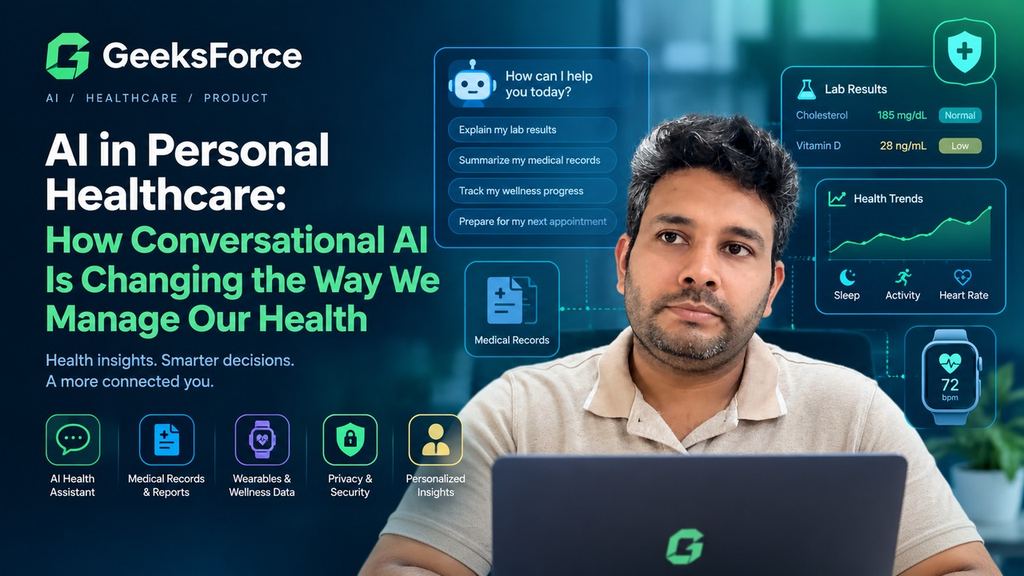
Managing personal health often means navigating multiple disconnected sources of information.
Lab results are stored in patient portals. Prescriptions are recorded in pharmacy applications. Fitness information lives in wearable devices. Appointment notes and medical histories may be scattered across different healthcare providers.
Even when people have access to this information, understanding how everything fits together can be difficult.
Artificial intelligence is beginning to change this experience.
Modern AI-powered healthcare assistants can help people understand medical terminology, organize health information, explore wellness trends, prepare questions for appointments, and make better use of the information they already have.
The emergence of conversational health experiences, including OpenAI’s ChatGPT Health, demonstrates how AI assistants are evolving beyond general-purpose question-and-answer tools toward more personalized interactions grounded in user-provided information.
But the opportunity goes much further than chatbots.
AI can help create a more connected healthcare experience by bringing together patient information, wellness applications, digital health platforms, and healthcare workflows.
In this article, we explore how AI is changing personal healthcare, the technologies behind these applications, their practical benefits, and the engineering considerations involved in building trustworthy healthcare AI solutions.
What Is AI in Personal Healthcare?
AI in personal healthcare refers to the use of artificial intelligence technologies to help individuals understand, organize, and manage information related to their health and wellness.
These technologies can include large language models (LLMs), machine learning algorithms, natural language processing, predictive analytics, and computer vision.
Unlike traditional healthcare software, which often requires users to navigate predefined forms, reports, and dashboards, conversational AI allows people to interact with health information using natural language.
For example, someone might ask:
- Can you explain my latest cholesterol test results?
- What changed between my last two blood reports?
- Help me prepare questions for my next doctor’s appointment.
- How has my sleep changed over the past month?
- Summarize the medications listed in my medical records.
- Help me create a realistic fitness routine based on my activity data.
Depending on the application and the information available, an AI assistant can retrieve relevant data, explain terminology, identify patterns, and organize the information into a more understandable format.
The important distinction is that AI can support health literacy and care navigation without replacing professional medical judgment.
From General AI Chatbots to Personalized Health Assistants
Early healthcare chatbots primarily relied on predefined responses, decision trees, or limited question-and-answer workflows.
They could answer common questions, provide basic health information, and guide users through simple processes.
Generative AI introduces a more flexible interaction model.
Modern LLM-based assistants can interpret complex questions, maintain conversational context, summarize documents, and explain information in everyday language.
The next evolution is personalization.
Instead of answering every question using general information alone, a health assistant can use information the individual has explicitly provided or connected, subject to permissions and the application’s capabilities.
For example, consider two people asking:
“What should I discuss with my doctor at my next appointment?”
A general chatbot might provide a standard checklist.
A personalized assistant could potentially consider recent test results, previous appointment notes, current medications, and the individual’s stated concerns to help prepare more relevant questions.
This is the direction represented by products such as ChatGPT Health, which OpenAI introduced as a dedicated experience for connecting health information and supporting more informed conversations.
The broader opportunity is to build healthcare applications that understand context rather than treating every interaction as an isolated question.
How AI Is Being Used in Personal Healthcare
1. Understanding Medical Reports and Lab Results
Medical reports frequently contain abbreviations, reference ranges, technical terminology, and measurements that are unfamiliar to patients.
AI assistants can help explain what these terms mean and organize results into understandable summaries.
For example, a user could upload a blood test report and ask:
“Explain these results in simple language and identify which values are outside the laboratory’s reference ranges.”
An AI-powered application could:
- Extract values from a document.
- Identify test names and measurement units.
- Compare results with the reference ranges shown on the report.
- Explain relevant medical terminology.
- Highlight values that may require discussion with a healthcare professional.
- Compare current results with previous reports when available.
This can improve health literacy and help people prepare more informed questions.
However, a laboratory reference range is not the same as an individual diagnosis. Interpretation depends on clinical context, medical history, symptoms, and other factors. AI-generated explanations should not be treated as a substitute for professional evaluation.
2. Personal Health Record Summarization
Many individuals receive healthcare from multiple providers, making it difficult to maintain a complete understanding of their medical history.
AI can help organize information from supported medical records, appointment summaries, and user-provided documents.
Potential capabilities include:
- Summarizing previous medical visits.
- Creating timelines of important health events.
- Organizing medication information.
- Identifying missing or outdated information.
- Preparing concise summaries for future appointments.
For example, a patient who has visited several specialists could use an AI assistant to create a structured summary of previous appointments and questions that remain unresolved.
This is particularly useful when information is spread across different documents and healthcare systems.
3. Medication Understanding and Management
Medication management can become complicated when individuals take multiple prescriptions or receive treatment from different providers.
AI applications can help users organize medication lists, understand general medication information, and prepare questions for pharmacists or physicians.
Possible features include:
- Medication list summarization.
- Reminders based on clinician-provided schedules.
- Explanation of prescription instructions.
- Identification of duplicate entries for review.
- Questions to ask about possible interactions or side effects.
Medication safety requires particular caution. An AI assistant should not independently change dosages, discontinue prescriptions, or recommend combining medications without appropriate clinical oversight.
A reliable application should distinguish between explaining existing information and making clinical recommendations.
4. Wellness and Fitness Personalization
Health management extends beyond medical appointments.
Sleep, physical activity, nutrition, and daily routines all contribute to an individual’s overall wellness.
AI applications can combine user-provided goals with information from connected fitness platforms and wearables to provide more relevant wellness guidance.
For example, an assistant might help users:
- Understand changes in their daily activity.
- Review sleep patterns.
- Track progress toward fitness goals.
- Build realistic exercise routines.
- Organize nutrition information.
- Identify changes in habits over time.
A personalized assistant could also consider practical constraints such as available time, activity preferences, and equipment.
This makes AI particularly useful for everyday wellness support, provided recommendations remain appropriately scoped and do not overstate what can be inferred from consumer health data.
5. Preparing for Doctor Appointments
Patients sometimes struggle to remember important questions during medical appointments.
They may also have difficulty summarizing symptoms, identifying relevant changes, or explaining what happened since their previous visit.
AI can help prepare structured appointment notes.
For example, a patient could ask an assistant to:
- Summarize recent symptoms based on their notes.
- Organize questions by priority.
- Compare current concerns with previous appointment notes.
- Create a list of medications and supplements to discuss.
- Summarize recent test results.
This can make conversations with healthcare professionals more organized and productive.
The goal is not to replace the consultation. It is to help patients participate more effectively in it.
6. Understanding Long-Term Health Trends
A single measurement rarely tells the complete story.
Changes in blood pressure, weight, activity, sleep, and other measurements may be more meaningful when viewed over time and in the context of relevant health information.
AI can help users explore these patterns by summarizing changes, generating charts, and identifying questions worth discussing with a healthcare professional.
For example:
“Compare my activity and sleep over the last three months. What patterns should I pay attention to?”
An assistant could organize the available measurements and explain observable trends.
It should distinguish between correlation and causation. If sleep and activity changed together, that does not automatically establish that one caused the other.
ChatGPT Health: An Example of the Emerging Personal Health Experience
One notable example of this direction is ChatGPT Health.
Introduced by OpenAI in January 2026, the experience was designed to bring health information and conversational AI together in a dedicated environment.
Its capabilities include helping users understand health information, prepare for appointments, explore wellness patterns, and connect supported health data sources.
The experience has continued to evolve. In July 2026, OpenAI announced a broader rollout to eligible adult users in the United States, with support for connecting Apple Health and supported medical records.
Depending on availability and connected services, users can explore information such as:
- Medical records and laboratory results.
- Medication information.
- Sleep and activity data.
- Recent healthcare visits.
- Wellness trends.
Users can ask questions that draw on relevant connected information with their permission.
For example, someone could ask an assistant to compare a recent laboratory result with a previous test or summarize changes since their last appointment.
An important aspect of this approach is that the assistant is designed to support healthcare navigation and wellness understanding, not replace medical care or provide a definitive diagnosis or treatment.
It also demonstrates an important product-design principle: personalization becomes more useful when an application can access relevant context with the individual’s consent.
Availability note: ChatGPT Health’s supported connections and availability are subject to regional and account eligibility restrictions. At the time of writing, its announced general rollout is for eligible users in the United States. Features and supported integrations may change.
Technologies Behind AI-Powered Healthcare Applications
Building a personalized health assistant requires more than integrating an LLM into a chat interface.
The application must retrieve relevant information, understand the user’s context, enforce access permissions, and generate responses that are grounded in appropriate sources.
Several technologies work together to make this possible.
1. Large Language Models
LLMs provide the conversational interface and language-understanding capabilities.
They can interpret questions, summarize medical documents, explain terminology, and generate structured responses.
Depending on the use case, developers may integrate models through APIs or deploy suitable models within controlled infrastructure.
The model should not be treated as the authoritative source of clinical truth. Important outputs need to be grounded in reliable information and evaluated for the intended use.
2. Retrieval-Augmented Generation (RAG)
RAG allows an AI application to retrieve relevant information from approved data sources before generating an answer.
For example, a health assistant could retrieve:
- Relevant sections of a patient’s uploaded medical records.
- Previous laboratory results.
- Medication information.
- Approved healthcare reference material.
- Relevant appointment summaries.
The retrieved information is then supplied as context to the language model.
This can make responses more relevant and easier to verify than relying exclusively on the model’s pretrained knowledge.
For healthcare applications, retrieval must also respect user permissions, document provenance, data freshness, and the distinction between patient-specific records and general medical references.
3. Medical Document Processing
Healthcare applications often need to work with PDFs, scanned reports, images, and structured medical documents.
Document-processing pipelines can use optical character recognition (OCR), layout analysis, data extraction, and validation to convert these documents into usable information.
A typical pipeline might:
- Receive an uploaded document.
- Identify its document type.
- Extract relevant text and tables.
- Map recognized fields to a structured schema.
- Validate extracted values and units.
- Store the document and extracted data securely.
- Make approved information available for retrieval.
Extraction confidence and source references are important. Incorrectly reading a decimal point or measurement unit can change the meaning of a medical result.
4. Healthcare Data Integrations
Personal health applications become more useful when they can connect to trusted data sources.
Depending on the market and integration permissions, this may include:
- Electronic health record (EHR) systems.
- Patient portals.
- Fitness applications.
- Wearable devices.
- Laboratory systems.
- Pharmacy platforms.
- Healthcare scheduling systems.
Standards such as FHIR can help applications exchange structured healthcare information with compatible systems.
However, integration is not automatic. Each provider may have different API capabilities, authorization requirements, data models, and access restrictions.
5. Analytics and Visualization
Health measurements are often easier to understand when presented visually.
A healthcare application can use charts and dashboards to display changes over time, compare measurements, and summarize relevant activity.
Examples include:
- Weight trends.
- Blood pressure history.
- Sleep duration.
- Activity levels.
- Laboratory result history.
- Medication adherence records, where reliable data is available.
The visualization layer should preserve units, dates, reference ranges, and data provenance so users can understand what is being displayed.
A Practical Architecture for Building an AI Health Assistant
A production-ready healthcare AI application needs a secure architecture that separates data ingestion, AI processing, application logic, and user access.
A typical architecture could include:
| Component | Responsibility |
|---|---|
| React / Next.js frontend | Conversational interface, health dashboard, document uploads |
| FastAPI / Node.js backend | Authentication, APIs, business logic, integrations |
| LLM service | Natural-language understanding and response generation |
| RAG pipeline | Retrieval of relevant health records and approved reference material |
| Document processing | OCR, extraction, and structured data validation |
| PostgreSQL | Users, health records metadata, permissions, and structured measurements |
| Vector database | Semantic retrieval of approved documents |
| Secure object storage | Medical reports and uploaded documents |
| Integration layer | EHR, FHIR, wearable, and healthcare provider connections |
| Monitoring and audit | Application activity, access logs, errors, and AI evaluation |
A simplified request flow looks like this:
User question → Authentication and permissions → Relevant data retrieval → AI processing → Response validation → User-facing answer
The most important architectural principle is that the LLM should not have unrestricted access to patient records or healthcare systems.
The backend should control which information can be retrieved, what actions are permitted, and what information can be returned to the user.
Privacy, Security, and Healthcare Compliance
Healthcare applications handle some of the most sensitive personal information.
A health assistant that processes medical records, prescriptions, or patient communications must be designed with privacy and security as core architectural requirements.
Protect sensitive health information
Use encryption in transit and at rest, secure authentication, appropriate access controls, and carefully managed encryption keys.
Sensitive information should only be available to authorized users and services.
Implement role-based access control
Different users may have different responsibilities.
For example, a patient should access their own records, while a healthcare professional should only access information permitted by the provider’s policies and the patient’s authorization.
Permissions must be enforced at the application and data layers, not simply described in AI prompts.
Maintain audit logs
Applications should maintain appropriate records of:
- Who accessed a patient’s information.
- Which records were viewed or modified.
- Which external systems were accessed.
- Which AI-powered operations were performed.
- When sensitive data was exported or shared.
Auditability is important for security investigations and compliance reviews.
Understand HIPAA obligations
For applications serving U.S. healthcare organizations, HIPAA requirements may apply depending on the organization’s role and how protected health information is handled.
If a cloud service provider creates, receives, maintains, or transmits electronic protected health information on behalf of a covered entity or business associate, the arrangement generally requires an appropriate Business Associate Agreement (BAA) and compliance with applicable HIPAA requirements.
A BAA alone does not make an application HIPAA-compliant. Organizations must also implement appropriate administrative, physical, and technical safeguards and conduct risk assessments.
The same principle applies to AI providers, document-processing services, cloud storage, and other vendors that may handle protected health information.
Evaluate clinical and regulatory boundaries
Not every health application is regulated as a medical device. However, intended use and functionality matter.
An application that explains general wellness information is different from software that makes patient-specific diagnostic or treatment recommendations.
In the United States, developers should assess applicable FDA digital health and clinical decision-support guidance when building software that may influence clinical decisions.
Be transparent about AI limitations
Users should understand when they are interacting with an AI assistant and what it can and cannot do.
The application should avoid presenting uncertain AI-generated information as a confirmed diagnosis or treatment recommendation.
For urgent symptoms, it should direct users toward appropriate emergency or professional care rather than continuing an ordinary chatbot conversation.
Challenges in Building Trustworthy AI Healthcare Applications
Despite the opportunities, healthcare AI introduces engineering and operational challenges.
Hallucinations and incorrect medical information
LLMs can produce confident but inaccurate answers.
This is particularly concerning when users interpret an explanation as a medical recommendation.
How to address it: Use approved information sources, RAG, response validation, clear uncertainty handling, and clinical review where appropriate. Evaluate the application using representative healthcare scenarios before deployment.
Incomplete or inconsistent patient records
A patient’s information may be spread across different providers, formats, and systems.
An assistant may have access to only part of the medical history.
How to address it: Display data provenance, identify missing information, track record dates, and avoid assuming that the connected data represents a complete medical history.
Incorrect document extraction
OCR and document-processing models can misread laboratory values, medication names, dates, or units.
How to address it: Validate extracted information, retain the original documents, flag low-confidence fields, and allow appropriate correction and review.
Integration complexity
Healthcare providers may use different EHR platforms, APIs, authentication systems, and data formats.
How to address it: Use standards such as FHIR where supported, build modular integration services, and establish a clear fallback process when a provider does not offer the required API access.
User trust and adoption
People may hesitate to share sensitive health information with an AI application or may not understand the limits of its responses.
How to address it: Make permissions understandable, explain how data is used, provide transparent source information, and keep users in control of their connected accounts and records.
How Businesses Can Start Building AI Healthcare Products
Organizations do not need to begin with an all-encompassing AI healthcare platform.
A focused product can demonstrate value while keeping technical and regulatory complexity manageable.
A practical implementation roadmap could look like this:
Phase 1: Identify the use case
Choose a specific problem, such as medical report summarization, appointment preparation, wellness tracking, or patient education.
Define the intended users, data sources, and boundaries of the application.
Phase 2: Design the data architecture
Determine how information will be collected, stored, retrieved, and protected.
Identify the required integrations, document formats, and permission model.
Phase 3: Build the AI workflow
Integrate the LLM, retrieval pipeline, document-processing services, and response-generation logic.
Establish rules for unsupported questions, missing information, and potentially unsafe requests.
Phase 4: Implement security and compliance controls
Review the applicable privacy and regulatory requirements. Implement authentication, authorization, encryption, audit logging, retention policies, and vendor agreements as required.
Phase 5: Test with realistic scenarios
Evaluate document extraction, response accuracy, access permissions, hallucination behavior, and application reliability.
For clinical functionality, involve appropriately qualified healthcare professionals in the evaluation process.
Phase 6: Launch a controlled pilot
Start with a limited user group and defined functionality.
Collect feedback, measure performance, investigate failures, and expand only when the system demonstrates acceptable reliability and safety.
The Future of Personal Healthcare Is Connected and AI-Assisted
The next generation of personal healthcare applications will likely combine conversational AI with connected medical records, wearable devices, healthcare platforms, and personalized digital experiences.
Rather than requiring users to navigate separate applications for every task, these systems may provide a more unified way to understand health information and prepare for interactions with healthcare professionals.
We can expect continued development in areas such as:
- More capable AI health assistants.
- Better interoperability between patient records and wellness applications.
- More personalized health education.
- Improved document understanding and medical record summarization.
- Natural-language interfaces for healthcare platforms.
- AI-supported patient engagement and care navigation.
- More sophisticated privacy and governance controls.
The most successful products will not necessarily be the ones with the most advanced models. They will be the ones that combine useful AI capabilities with trusted data, thoughtful user experiences, reliable integrations, and responsible engineering.
Build AI-Powered Healthcare Applications With GeeksForce
Healthcare technology is moving toward more connected, personalized, and intelligent digital experiences.
Building these products requires expertise across AI engineering, healthcare integrations, backend development, application security, and user experience design.
At GeeksForce, we help businesses transform ideas into production-ready software through AI-powered application development and custom software engineering.
Our healthcare and AI engineering capabilities can support projects involving:
- AI-powered health assistants and conversational interfaces.
- Medical document processing and information extraction.
- RAG-based healthcare knowledge systems.
- EHR and healthcare API integrations.
- Patient portals and healthcare management platforms.
- Secure cloud-based healthcare applications.
- AI workflow automation and intelligent data processing.
Whether you are developing a healthcare startup, modernizing an existing patient platform, or exploring how AI can improve healthcare workflows, the right solution starts with a clear use case and a secure technical foundation.
Planning an AI-powered healthcare product? Visit GeeksForce to discuss your healthcare software and AI development requirements.
Frequently Asked Questions
What is an AI healthcare assistant?
An AI healthcare assistant is a software application that uses artificial intelligence to help users access, understand, and organize health-related information. Depending on its design, it may support medical document summaries, appointment preparation, wellness tracking, and general health education.
Can ChatGPT analyze medical reports?
AI assistants can help explain information contained in uploaded medical reports, including laboratory values and medical terminology. However, the interpretation may be incomplete or incorrect and should not replace evaluation by a qualified healthcare professional.
What is ChatGPT Health?
ChatGPT Health is a dedicated health experience from OpenAI that allows eligible users to connect supported health information and have more personalized conversations. It can help users understand records, explore wellness patterns, and prepare for appointments. It is designed to support, not replace, medical care and is not intended for diagnosis or treatment.
Can AI connect to electronic health records?
Yes. Healthcare applications can integrate with compatible EHR systems using APIs and standards such as FHIR. Availability depends on the provider, its integration capabilities, authentication requirements, and applicable permissions.
Is AI healthcare software HIPAA-compliant?
AI software is not automatically HIPAA-compliant. Compliance depends on the application’s intended use, the organizations involved, how protected health information is handled, applicable vendor agreements, and the safeguards implemented throughout the system.
Can AI replace doctors?
No. AI can support health education, information organization, administrative workflows, and selected clinical support functions, but it should not be treated as a replacement for qualified medical professionals.
What technologies are used to build AI healthcare applications?
Common technologies include LLMs, retrieval-augmented generation, Python, FastAPI, React, PostgreSQL, vector databases, OCR, healthcare APIs, and cloud infrastructure. The appropriate stack depends on the product’s functionality, data requirements, security needs, and regulatory obligations.
How much does it cost to build an AI healthcare application?
The cost depends on the scope of the product, number of integrations, complexity of AI workflows, security requirements, regulatory considerations, and infrastructure. A focused health assistant prototype will generally require less engineering effort than a production platform integrating multiple EHR systems and handling sensitive patient information.