
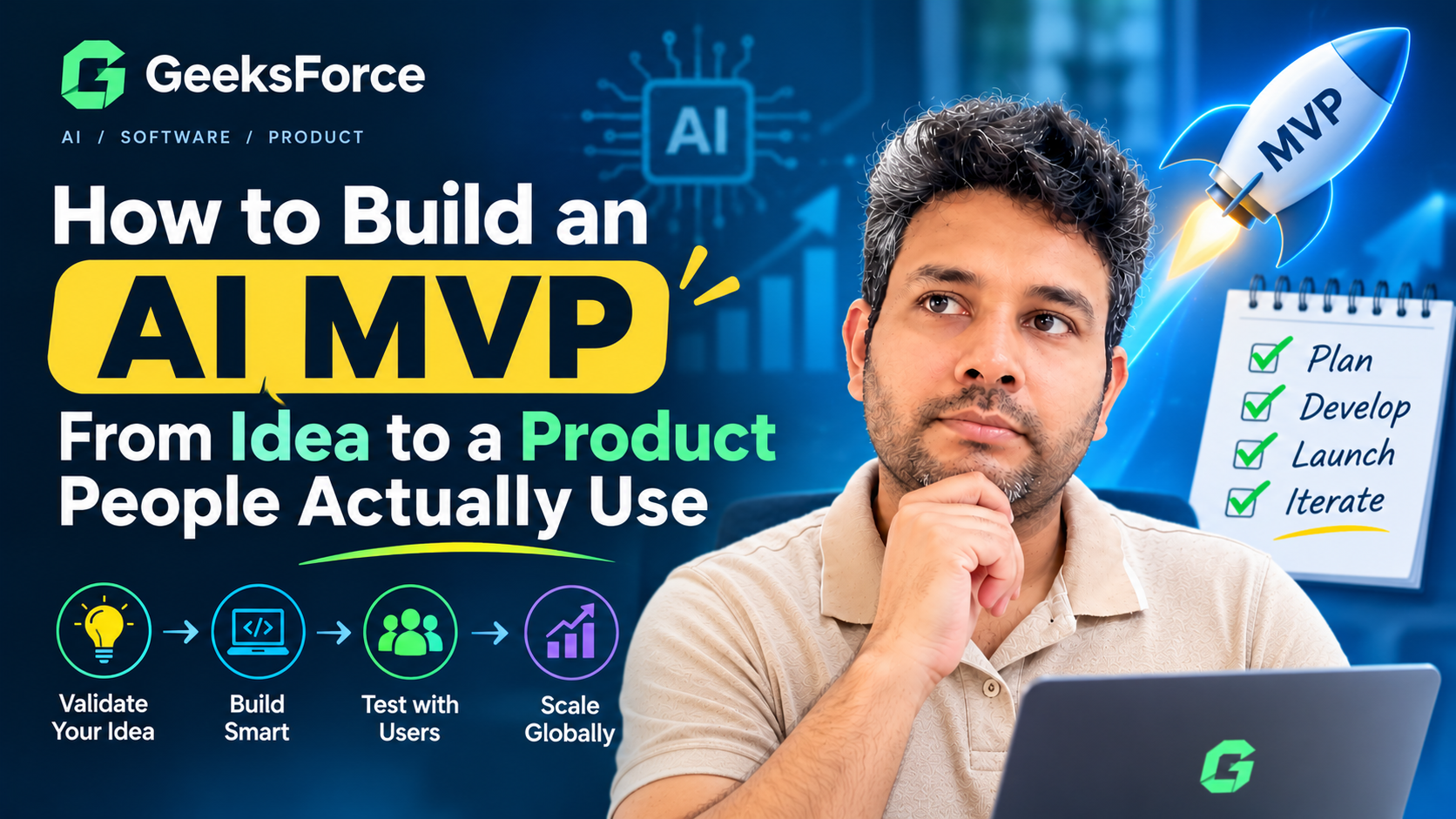
How to Build an AI MVP: From Idea to a Product People Actually Use
AI has made it easier than ever to turn an idea into a working software product.
A founder can describe an idea to an AI assistant, generate a basic interface, connect an API, and have a prototype running in days.
But building a prototype is not the same as building a viable product.
Many AI startups fail because they start with the technology instead of the problem. They build an impressive chatbot, automation tool, or AI agent—but struggle to answer a more important question:
Why would someone use this product instead of the tools they already have?
This is where an AI Minimum Viable Product, or AI MVP, becomes valuable.
An MVP helps you test the core assumption behind your product with the smallest practical version of the solution. Instead of spending months building every feature, you focus on the problem, the users, and the one capability that creates real value.
In this guide, we’ll explore how to develop an AI MVP—from validating the idea to selecting the technology and preparing for production.
What Is an AI MVP?
An AI MVP is the smallest version of an AI-powered product that allows you to test whether your solution provides value to real users.
It does not need every feature you imagine for the final product.
It needs to solve one important problem well enough for users to try it and provide meaningful feedback.
For example, imagine you want to build an AI platform for healthcare clinics.
Your long-term vision might include:
- AI appointment assistants
- Patient communication
- Medical document processing
- Automated workflows
- Analytics dashboards
- EHR integrations
Trying to build everything at once could take months and require a significant investment.
A better MVP might focus on one problem:
Help clinic staff summarize incoming patient documents and route them to the right workflow.
This creates a focused product that can be tested with real users.
The lesson is simple:
Your MVP should test your biggest assumption—not demonstrate every feature your product may eventually have.
Step 1: Start With the Problem, Not the AI
The biggest mistake in AI product development is starting with a model.
Founders often ask:
Which AI model should we use?
That is usually not the first question.
Start by asking:
- Who has the problem?
- How are they solving it today?
- What makes the current process difficult?
- How frequently does the problem occur?
- What would a better solution be worth?
For example, “an AI chatbot for businesses” is not a clearly defined problem.
But this is more specific:
“Customer support teams spend several hours every day searching through internal documentation to answer repetitive technical questions.”
Now you have a problem that AI may help solve.
The AI component should support the solution—not become the product’s entire reason for existing.
Step 2: Define Your Core User and Use Case
An MVP should have a clear user.
Trying to build for everyone usually results in a product that feels generic.
Instead of saying:
“Our AI tool helps businesses.”
Define the target user more precisely:
“Our product helps small healthcare practices reduce the time staff spend organizing patient inquiries.”
The more clearly you understand the user, the easier it becomes to make product decisions.
Create a simple use-case statement:
[User] needs to [complete a task] because [current problem].
For example:
A property manager needs to quickly summarize tenant maintenance requests because reviewing and categorizing hundreds of messages manually takes too much time.
This statement can become the foundation of your MVP.
Step 3: Choose One Core AI Capability
AI products often become unnecessarily complicated because founders try to use every available AI feature.
Your MVP might only need one of these capabilities:
Conversational AI
Useful for assistants, support tools, and natural-language interfaces.
Document Intelligence
Useful for extracting and summarizing information from PDFs, forms, and other documents.
Retrieval-Augmented Generation (RAG)
Useful when an AI needs to answer questions using your company’s private knowledge base.
AI Agents
Useful when AI needs to perform multiple steps or interact with other software systems.
Computer Vision
Useful for analyzing images and video.
Predictive Machine Learning
Useful for forecasting, classification, and identifying patterns in structured data.
Choose the technology based on the problem.
The best AI MVP is not the one using the most advanced technology. It is the one that solves a real problem with the least unnecessary complexity.
Step 4: Decide What to Build and What to Buy
One of the most important decisions in AI MVP development is determining which components should be custom-built.
You usually do not need to build an AI model from scratch.
Modern AI APIs and cloud services allow startups to integrate powerful capabilities without investing in expensive infrastructure or machine learning research.
A typical AI MVP might use:
| Component | MVP Approach |
|---|---|
| AI models | Use a reliable API |
| Frontend | React or Next.js |
| Mobile application | React Native |
| Backend | Node.js or Python |
| Database | PostgreSQL |
| Authentication | Managed authentication service |
| File storage | Cloud object storage |
| AI orchestration | Custom workflow logic |
| Deployment | Cloud infrastructure |
The goal is to spend development time on the part that makes your product different.
If your competitive advantage is a unique workflow, customer experience, or industry-specific knowledge, that is where custom engineering should be focused.
Step 5: Build the Simplest End-to-End Workflow
A successful MVP should allow users to complete a real task from beginning to end.
For example:
User uploads a document → AI processes it → system returns useful information → user takes action
This is often more valuable than building several disconnected features.
Focus on the complete user journey.
Ask:
- What starts the workflow?
- What information does the system need?
- What does the AI do?
- What result does the user receive?
- What action can the user take next?
A simple end-to-end experience helps you test whether the product actually solves the intended problem.
Step 6: Design for AI Reliability
Traditional software generally behaves predictably.
If you enter the same input, you expect the same output.
AI systems are different.
Large language models can produce unexpected responses, misunderstand ambiguous requests, or generate inaccurate information.
Your MVP should account for this from the beginning.
Consider implementing:
- Input validation
- Structured AI outputs
- Response limits
- Source retrieval
- Error handling
- Human review for important actions
- Logging and monitoring
For example, instead of asking an AI model to return a completely free-form response, your application may request structured data.
This makes the output easier to validate and integrate with the rest of your system.
The AI model should be part of your application architecture—not an uncontrolled component with unrestricted access to your data and systems.
Step 7: Keep Your Data Architecture Simple
Startups sometimes over-engineer their infrastructure before they have validated the product.
For an MVP, keep the architecture focused.
A common structure could look like this:
Frontend → Backend API → Database + AI Services
Additional components can be introduced when the product requires them.
If your application uses private documents or company data, you may add a retrieval layer:
Frontend → Backend → Retrieval System → AI Model → Response
The important thing is to design an architecture that can evolve.
Your first version does not need to handle millions of users.
But it should avoid shortcuts that make future development unnecessarily difficult.
Step 8: Build Security Into the MVP
Speed matters when developing an MVP, but security should not be ignored.
This is especially important when your application handles:
- Customer information
- Financial data
- Healthcare records
- Business documents
- Internal company knowledge
At a minimum, consider:
- Secure authentication
- Role-based access
- Data encryption
- API security
- Secure file storage
- Environment variables for credentials
- Activity logging
If your product operates in a regulated industry, compliance requirements should be considered during the architecture phase—not after the product is already built.
An MVP can be small without being careless.
Step 9: Test With Real Users as Early as Possible
The purpose of an MVP is learning.
Do not wait until you have built the “perfect” product.
Find a small group of potential users and let them interact with the solution.
Pay attention to what they actually do—not only what they say they would do.
Useful questions include:
- Did the product solve the problem?
- Was the AI output useful?
- Where did users get confused?
- Would they use the product again?
- What would they pay for?
- What features did they expect?
You may discover that the problem is different from what you originally assumed.
That is a successful outcome.
Finding out early is much less expensive than discovering the same issue after months of development.
Common Mistakes When Building an AI MVP
Building Too Many Features
An MVP is not a smaller version of every feature in your future roadmap.
It should focus on the core value proposition.
Choosing AI Before Validating the Problem
Do not use AI simply because AI is popular.
Make sure it provides a meaningful advantage.
Training a Custom Model Too Early
Most startups do not need to train their own model for an MVP.
Existing AI models can often validate the product idea faster and at a lower cost.
Ignoring AI Costs
Every AI request may have a cost.
Monitor usage and consider:
- Token consumption
- Number of requests
- Document processing
- Storage
- Model selection
The most capable model may not be necessary for every task.
Giving AI Too Much Autonomy
AI should operate within defined boundaries.
For important actions, use validation and human approval.
Waiting Too Long for User Feedback
The longer you build without testing, the greater the risk of building something users do not want.
How to Measure an AI MVP
Downloads and sign-ups are useful metrics, but they do not always indicate product value.
Look at how users interact with the core workflow.
Possible metrics include:
- Number of users completing the main task
- Frequency of repeat usage
- Time saved
- Accuracy of AI-assisted tasks
- Human correction rate
- Cost per AI workflow
- Conversion from trial to paid usage
For example, if your AI application helps support teams process requests, a useful metric might be:
How much time does the workflow save compared with the previous manual process?
This connects your product directly to business value.
A Practical AI MVP Development Roadmap
Here is a straightforward approach for startups and businesses.
Week 1: Discovery and Validation
Define the user, problem, use case, and success criteria.
Week 2: Product and Technical Design
Create user flows, architecture, database structure, and AI workflow design.
Weeks 3–5: MVP Development
Build the core application and integrate the required AI capabilities.
Week 6: Testing and Refinement
Test the application with realistic data and early users.
After Launch: Learn and Iterate
Use feedback and product analytics to decide what to build next.
The exact timeline will depend on the complexity of the product, integrations, and regulatory requirements.
The key is to keep the first release focused.
From MVP to a Scalable AI Product
Once your MVP demonstrates real value, you can begin investing in additional capabilities.
This may include:
- More advanced AI workflows
- Additional integrations
- Improved personalization
- AI agents
- Analytics
- Team collaboration
- Enterprise security
- Mobile applications
The MVP provides the evidence you need to make better product decisions.
Instead of guessing which features matter, you can prioritize based on real user behavior.
Build Your AI MVP With GeeksForce
An AI idea is only valuable when it becomes a product that solves a real problem.
At GeeksForce, we help startups and businesses design and build practical AI-powered software products.
Our team can support your AI MVP from initial concept through production development, including:
- AI product strategy
- Custom web and mobile applications
- Generative AI integration
- RAG and knowledge-based AI systems
- AI agent development
- API and third-party integrations
- Cloud architecture
- Scalable backend development
We focus on building the right product for your business—not adding technology that your users do not need.
Whether you have an early-stage idea or an existing product that could benefit from AI, starting with a focused MVP can help you validate the opportunity before making a larger investment.
Have an AI product idea? Visit GeeksForce to discuss how we can help turn it into a working MVP.
Frequently Asked Questions
What is an AI MVP?
An AI MVP is the smallest practical version of an AI-powered product that allows a business or startup to test its core idea with real users.
How long does it take to build an AI MVP?
The timeline depends on the product’s complexity. A focused MVP can often be developed faster than a full-scale application because it concentrates on one core workflow.
Do I need to train my own AI model?
Usually, no. Many AI MVPs can be built using existing models and APIs. A custom model may become necessary later if the product has specialized requirements that existing solutions cannot meet.
How much does it cost to build an AI MVP?
The cost depends on the application’s scope, integrations, AI capabilities, and security requirements. A focused MVP is generally more affordable than building a complete platform with every planned feature.
What is the difference between an AI prototype and an MVP?
A prototype demonstrates how an idea might work. An MVP is a usable product designed to test whether real users find enough value in the solution.
Should my AI MVP use an AI agent?
Only if an agent is necessary for the core workflow. If a simple AI request or retrieval system solves the problem, adding an autonomous agent may create unnecessary complexity.
Final Thoughts
The fastest way to build an AI product is not always to build more.
It is to identify the most important problem, create the smallest solution that addresses it, and learn from real users.
Start with the problem.
Choose the technology that fits.
Build one valuable workflow.
Then improve the product based on evidence.
That is how an AI MVP becomes the foundation for a successful AI product.