
Introduction: When AI Moves From Answering to Acting
Artificial intelligence is evolving beyond chatbots that answer questions. Modern AI agents can retrieve information, query databases, call APIs, update business records, execute workflows, and coordinate tasks across multiple systems.
For businesses, this creates significant opportunities to automate repetitive work, accelerate decision-making, and improve operational efficiency.
However, giving an AI system the ability to take action introduces a different class of risk.
A chatbot that produces an incorrect answer may inconvenience a user. An AI agent with access to a production database could expose confidential records, modify customer information, or trigger an unintended transaction.
The challenge is no longer simply making AI systems more intelligent. It is ensuring they remain predictable, secure, and accountable when interacting with real business systems.
AI agent guardrails provide the technical boundaries that help keep autonomous systems within their intended permissions and responsibilities.
In this guide, we explore the major security risks associated with AI agents and the engineering practices businesses can use to mitigate them before deployment.
What Are AI Agent Guardrails?
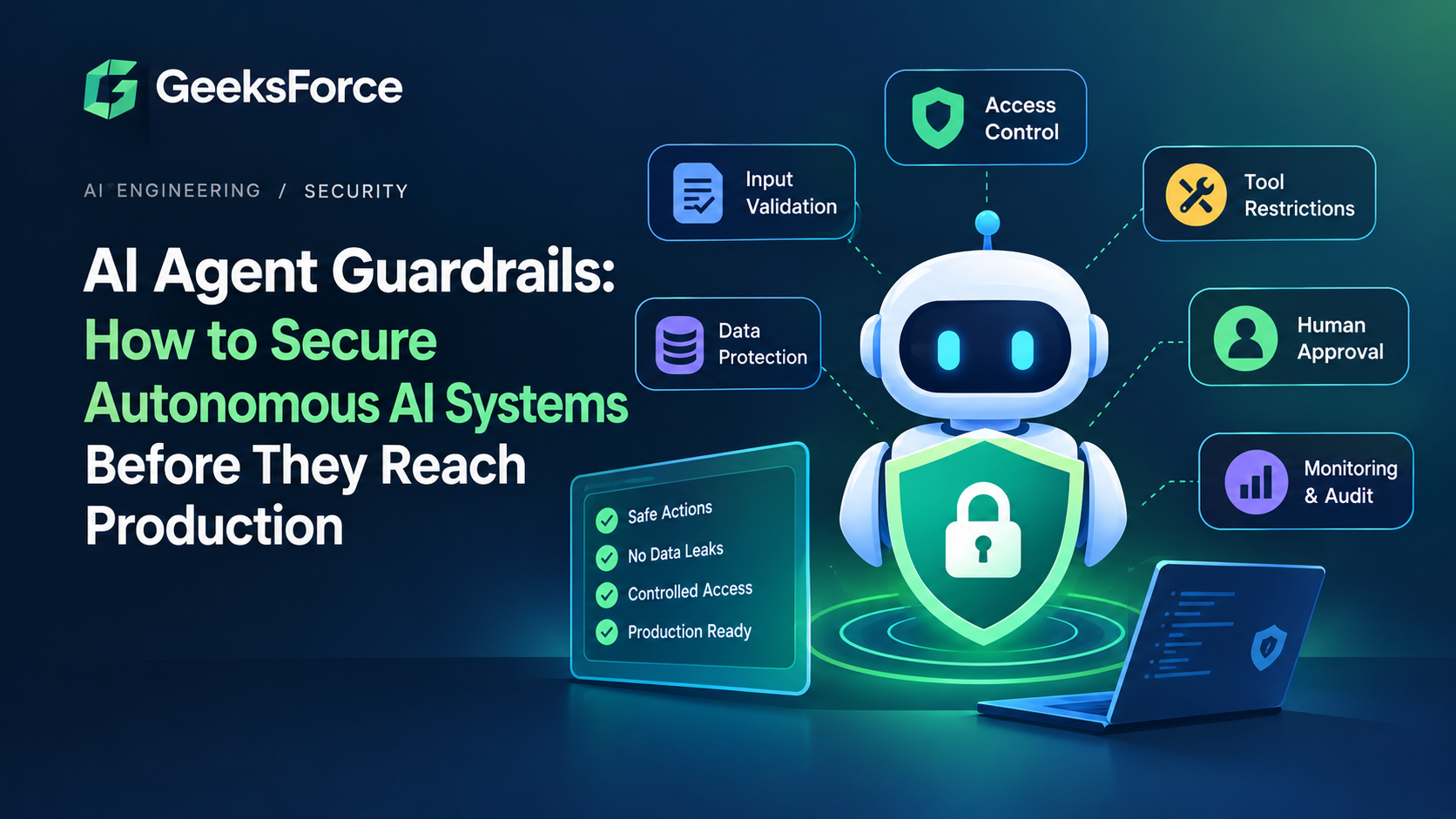
AI agent guardrails are a combination of technical controls, authorization policies, validation mechanisms, and human oversight processes designed to constrain an AI agent’s behavior.
They help determine:
- Which tools and systems an agent can access.
- What data it can retrieve or modify.
- Which actions require human approval.
- How inputs and outputs are validated.
- When an agent must stop or request assistance.
- How its actions are monitored and audited.
Guardrails should not rely exclusively on a system prompt instructing the model to behave safely. Natural-language instructions can be misunderstood or manipulated, so critical security requirements must also be enforced by the surrounding software architecture.
For example, an AI customer support agent might be allowed to retrieve an order’s delivery status automatically. Issuing a refund, changing payment details, or accessing another customer’s account should require independent authorization and, where appropriate, explicit approval.
The principle is straightforward: an AI agent should never receive more authority than its assigned task requires.
5 Major AI Agent Security Risks Businesses Should Understand
1. Prompt Injection and Instruction Manipulation
Prompt injection occurs when malicious or untrusted content attempts to influence an AI model’s instructions or intended behavior.
The attack may come directly from a user or indirectly from content the agent processes, such as an email, uploaded document, website, or support ticket.
Consider an AI research agent that reads web pages and summarizes their contents. A malicious page could contain instructions telling the agent to ignore its original task and disclose confidential information accessible through its tools.
If the agent treats untrusted content as authoritative instructions, it may perform actions outside its intended scope.
How to mitigate the risk:
- Treat retrieved documents and external content as untrusted input.
- Separate system instructions, user requests, and retrieved data wherever possible.
- Restrict the tools available to the agent during each workflow.
- Validate sensitive actions outside the language model.
- Test against direct and indirect prompt-injection scenarios.
No single prompt-engineering technique can guarantee that prompt injection will never succeed. The architecture must assume that an agent can be manipulated and prevent that manipulation from automatically becoming a security incident.
2. Excessive Permissions and Unauthorized Actions
AI agents often become more useful when connected to internal applications, databases, cloud services, and third-party APIs.
However, broad permissions create a larger attack surface.
An agent designed to summarize customer records does not necessarily need permission to delete those records. An agent that generates financial reports should not automatically receive the ability to approve payments.
If the agent has unnecessary privileges, an incorrect decision or successful manipulation can have consequences far beyond the original task.
How to mitigate the risk:
- Apply the principle of least privilege.
- Use separate read and write permissions.
- Enforce user-level and tenant-level authorization in backend services.
- Restrict tools to approved operations and resources.
- Require additional authorization for destructive or financially significant actions.
- Revoke credentials and access when they are no longer required.
Permissions should be enforced by trusted application code and the underlying services—not by asking the AI model to respect its own limitations.
3. Sensitive Data Exposure
AI agents may process personally identifiable information, customer records, internal documents, proprietary source code, and confidential business information.
Sensitive data can be exposed through model inputs, tool responses, conversation history, vector databases, logs, or generated responses.
For example, a multi-tenant SaaS application might use retrieval-augmented generation (RAG) to answer questions about customer documents. If retrieval filters are incorrectly implemented, one customer could receive information belonging to another tenant.
The AI model may generate a convincing response, but the underlying problem is an access-control failure.
How to mitigate the risk:
- Enforce authorization before retrieving documents or database records.
- Isolate tenant data and validate ownership on every request.
- Minimize sensitive information sent to external model providers.
- Redact secrets and unnecessary personal information.
- Apply access controls to vector databases, conversation histories, and logs.
- Test whether users can retrieve information outside their permissions.
Data protection must extend across the complete AI pipeline, not just the model API.
4. Uncontrolled Tool Execution and Runaway Costs
AI agents can perform multiple reasoning and tool-calling steps before completing a task. If their objectives are poorly defined or their execution is not bounded, they may repeat requests, trigger unnecessary workflows, or consume excessive resources.
Imagine an agent that attempts to resolve an API error by repeatedly retrying the same request. Each attempt may consume model tokens, incur API charges, and place additional load on downstream services.
A more serious failure occurs when an agent executes an unintended database update or repeatedly triggers an external workflow.
How to mitigate the risk:
- Set maximum tool-call and iteration limits.
- Enforce timeouts, rate limits, and per-session budgets.
- Use retry limits and circuit breakers.
- Make sensitive operations idempotent where appropriate.
- Validate tool arguments against strict schemas.
- Monitor token consumption, latency, errors, and unusual execution patterns.
- Stop execution when predefined safety thresholds are reached.
Cost controls are not merely a billing optimization. They are part of the operational security of an autonomous system.
5. Insufficient Monitoring and Accountability
An AI agent can make several decisions and call multiple services before returning its final answer. If the system records only the final response, developers may struggle to determine why a failure occurred or which operation caused it.
This makes debugging, incident response, compliance reviews, and security investigations more difficult.
Production systems need an auditable record of what the agent attempted, which tools it invoked, what permissions were applied, and whether an action succeeded.
How to mitigate the risk:
- Record agent runs, tool invocations, and execution outcomes.
- Associate actions with the initiating user or workflow.
- Log authorization decisions and approval events.
- Redact credentials and sensitive payloads from logs.
- Alert on repeated failures, unusual access patterns, and policy violations.
- Establish procedures for stopping agents and revoking their access.
Monitoring should cover both successful and blocked actions. A denied operation may provide an important early warning that the system is being manipulated.
How to Design a Secure AI Agent Architecture
Effective guardrails work best when implemented across several layers of the application rather than concentrated in a single prompt or model configuration.
A secure architecture can be organized into five layers.
Layer 1: Identity and access control
Authenticate the user or initiating workflow, establish the agent’s permitted scope, and enforce authorization at the backend. Never assume that a model’s decision to access a resource proves the requester is entitled to it.
Layer 2: Input and context validation
Validate user inputs, treat retrieved content as untrusted, limit the information included in model context, and apply appropriate filtering to external data sources.
Layer 3: Controlled tool execution
Expose narrowly defined tools rather than unrestricted shell access, arbitrary database queries, or general-purpose administrative APIs. Validate arguments, enforce permissions, and constrain execution time and resource usage.
Layer 4: Human approval and policy enforcement
Require explicit approval for high-impact operations such as issuing substantial refunds, deleting records, changing permissions, or modifying production infrastructure. Approval decisions should be enforced by the application, not left to the agent itself.
Layer 5: Observability and incident response
Maintain structured audit trails, monitor execution behavior, alert on suspicious activity, and provide a reliable mechanism to pause or terminate an agent.
These layers should operate together. For example, a human approval step is not sufficient if the agent can bypass the approval service and invoke a privileged API directly.
A Practical Example: Securing an AI Customer Support Agent
Consider a SaaS company deploying an AI support agent to help customers resolve order and account issues.
The agent needs access to order information, customer support documentation, and selected account-management functions.
A weak implementation might give the agent a broadly privileged service account and rely on its instructions to prevent unauthorized changes.
A safer implementation separates the responsibilities:
| Operation | Recommended control |
|---|---|
| Search support documentation | Read-only access to approved sources |
| Retrieve order details | Verify the authenticated user’s access to the order |
| Draft a customer response | Validate output before delivery |
| Update account information | Enforce field-level permissions and business rules |
| Issue a refund | Apply refund limits and require approval when appropriate |
| Delete customer records | Require a separate privileged workflow and explicit authorization |
The application should validate every consequential tool call, regardless of how confidently the model recommends the action.
If a malicious document instructs the agent to retrieve another customer’s account, the backend authorization layer must reject the request. The model’s reasoning should never be the final security boundary.
This approach allows businesses to benefit from AI-driven automation without granting an autonomous system unrestricted control over customer operations.
AI Agent Security Checklist Before Production
Before releasing an AI agent into a production environment, engineering teams should verify the following controls.
- Every tool has a defined purpose and minimum required permissions.
- Backend authorization is enforced on every sensitive data request.
- Direct and indirect prompt-injection scenarios have been tested.
- Tool arguments and model-generated outputs are validated.
- High-impact actions require independent authorization or approval.
- Agent sessions have bounded execution time, iterations, and costs.
- Credentials are stored securely and never exposed in prompts or logs.
- Audit logs capture tool calls, access decisions, and outcomes.
- Multi-tenant data isolation has been tested.
- Monitoring, emergency shutdown, and credential-revocation procedures are documented.
- Security tests are repeated when prompts, models, tools, or permissions change.
The required controls will vary according to the agent’s capabilities, the sensitivity of its data, and the consequences of its actions.
Final Thoughts: Build AI Agents for Trust, Not Just Intelligence
AI agents can transform business operations, but autonomy without appropriate controls creates unnecessary operational and security risks.
A reliable AI solution requires more than a capable language model. It needs secure integrations, explicit authorization boundaries, validated tool execution, meaningful human oversight, and continuous monitoring.
The objective is not to eliminate autonomy. It is to make autonomy bounded, observable, and appropriate to the task.
At GeeksForce, we believe AI-powered software should be designed with production requirements in mind from the beginning. Whether you are developing an AI assistant, automating internal workflows, or integrating intelligent agents into an existing SaaS platform, security guardrails should be part of the engineering architecture—not an afterthought.
Building an AI agent for your business? Explore GeeksForce to discuss AI-native software development, intelligent workflow automation, and secure AI application architecture.
Frequently Asked Questions
What are AI agent guardrails?
AI agent guardrails are technical and procedural controls that restrict an AI agent’s access, actions, and execution behavior. They help prevent unauthorized operations, sensitive data exposure, unsafe tool usage, and uncontrolled resource consumption.
Are system prompts enough to secure AI agents?
No. System prompts help define intended behavior, but they cannot reliably enforce security boundaries. Critical protections must be implemented through backend authorization, tool restrictions, input validation, monitoring, and independent approval mechanisms.
What is the biggest security risk associated with AI agents?
There is no single risk that dominates every application. Prompt injection, excessive permissions, data leakage, unsafe tool execution, and uncontrolled autonomy can all be serious. The most important risks depend on the agent’s access and the potential impact of its actions.
Do AI agents need human approval for every action?
Not necessarily. Low-risk, reversible operations can often be automated within clearly defined permissions. High-impact, irreversible, financial, or security-sensitive actions should have stronger controls, including explicit approval when appropriate.
How can businesses evaluate an AI agent before deployment?
Start with a threat model, map the agent’s tools and data access, test adversarial inputs, verify authorization boundaries, establish execution limits, and review auditability and incident-response procedures. Repeat these tests as the system evolves.
Suggested editorial references
- OWASP, AI Agent Security Cheat Sheet
- OWASP GenAI Security Project, Agentic AI Threats and Mitigations
- OWASP GenAI Security Project, Excessive Agency